
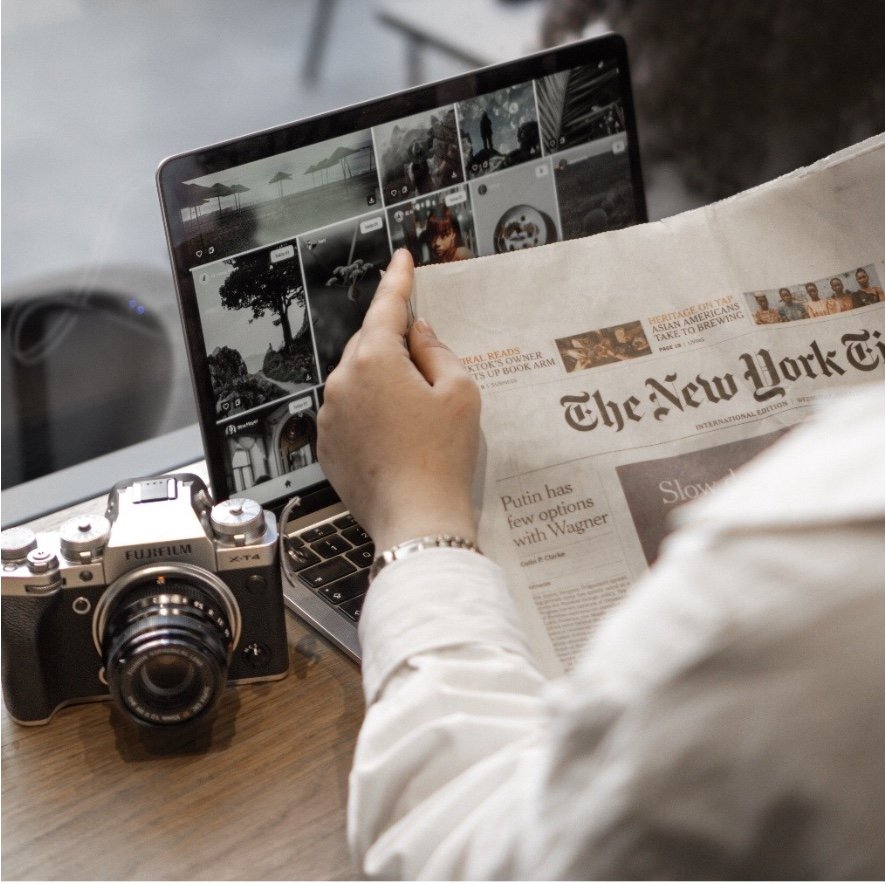
PHOTO: Close-up of a person reading The New York Times by a laptop and camera., Pexels., Beyzanur K., 2023.
Since I was 12 years old, I’ve been obsessed with the idea of social cohesion. Why? Because when I was in year 8, I went to a School Strike 4 Climate protest in the heart of Christchurch and was yelled at by a police officer to evacuate. There was a shooter in the city, and no one had any idea what was going on. In the days that followed, my life was changed forever. I remember people bringing our family gifts, my dad burning incense and listening to prayers from the Quaran. My siblings and I took the day off school for the National Memorial Service. It still hurts listening to Peace Train.
Later in the year, I begged my principal to allow teachers to educate our school on the different religions existing harmoniously in Aotearoa, because if we were all exposed to other cultures from the very beginning, we would be more accepting. We’d grow up knowing that in our super diverse country, where 25% of people are immigrants, multi-cultural communities are the norm. The principal came back to me and explained that my teachers said talking about religion would make them “uncomfortable”.
Their discomfort, and the discomfort of Aotearoa as a whole, had stopped me from being proud of my culture as a child. It led me to tell people I couldn’t eat pork because I was allergic. It led to me feeling othered.
I’ve always been a people pleaser. I don’t like making others feel uncomfortable. As a brown person, I’m constantly monitoring new people when I meet them. Is it okay to tell them where my family is from, or will that provoke a reaction? Should I correct them when they pronounce my name wrong? Or is it easier to just let them say it how they like?
As I transitioned into high school, my passion for social cohesion led me to research theories like Us vs Them mentality, which describes the subconscious comparison of differences. Throughout history, humans have formed in-groups and out-groups based on physical appearance, gender, social status, financial status, religion and race. People tend to favour their own in-group over any out-groups.
More research revealed the best way to break down this mentality and shift the lens from Us vs Them, to You and I, is through the media. I don’t think people realise how powerful the media is. Almost everything we believe and know to be true we have learnt and had reinforced by media. It shapes who we are, and in turn, we shape it.
9/11 was an atrocity for everyone involved. As a volunteer firefighter, it makes me cry thinking about the hundreds of firefighters who died in rescue attempts and decades later because of exposure to carcinogens. As well as everyone affected in New York, Muslims across the world have suffered post-9/11 because of the actions of a few terrible individuals.
Muslim men became turban wearing, AK-47 carrying, rage filled terrorists. Muslim women became enshrouded, obedient, Jihadi brides. The media perpetuated these stereotypes to the point they’ve become entrenched in the ideology of society.
I’ve read far too many news articles that identify race or religion for absolutely no reason. A piece about a stabbing on a train turns into a sensationalist story about a knife wielding immigrant. Publish enough stories about “immigrant problems” and you see fear in the public, an increase in racism, and anti-immigrant policies being declared. The same goes for the countless articles identifying those involved in crime as being Māori. I really struggle to think of a reason why someone’s ethnicity ever needs to be reported.
Research from the University of Alabama has found terrorist attacks committed by Muslim extremists receive considerably more US press coverage than those committed by non-Muslims. If an attack is carried out by a Muslim perpetrator, it will receive roughly 105 headlines compared to only 15 for non-Muslims. This is especially scary considering, “…out of 136 terror attacks in the U.S. over a span of 10 years… Muslims committed on average 12.5 percent of the attacks yet received more than half of the news coverage.”
This repeated news coverage, doubling down on the idea that Muslims are violent and bad people, has led to fear and racism across the world.
It’s in no way justified, and I do think the media should be held responsible.
CNN shows the misrepresentation of Muslims in the media is a problem being faced across the world, and beyond the news. Researchers from the University of Southern California’s Annenberg School for Communication and Journalism found after analysing over 200 TV shows, that despite Muslims making up 25% of the world’s population, they only count for 1% of speaking characters on TV.
87% of the shows they studied didn’t include a Muslim character at all, a third of Muslims shown were violent towards others, and 40% of Muslims were victims of violence, further reinforcing the stereotype that Muslim men are extreme and violent, and Muslim women are oppressed and fearful. According to the researchers, “These portrayals have real-life impact on the ways that viewers think about Muslims…”
I’m sick of my family being “randomly and routinely” bomb checked when we go to the airport. Reporting must be fair and accurate. Headlines should be 1:1, race and religion shouldn’t affect who gets prioritised in coverage, and journalism should never perpetuate stereotypes.
I’ve spent years trying to understand social cohesion, and the answers keep circling back to the same place. It’s the stories we tell, and the stories we are told. If we want a country where difference isn’t feared, then we need media that reflects reality rather than stereotypes.
Social cohesion isn’t an abstract idea. It’s built every day in classrooms, in newsrooms, and in the stories we choose to amplify. The media shapes our world, and it has a responsibility to shape it with care.