
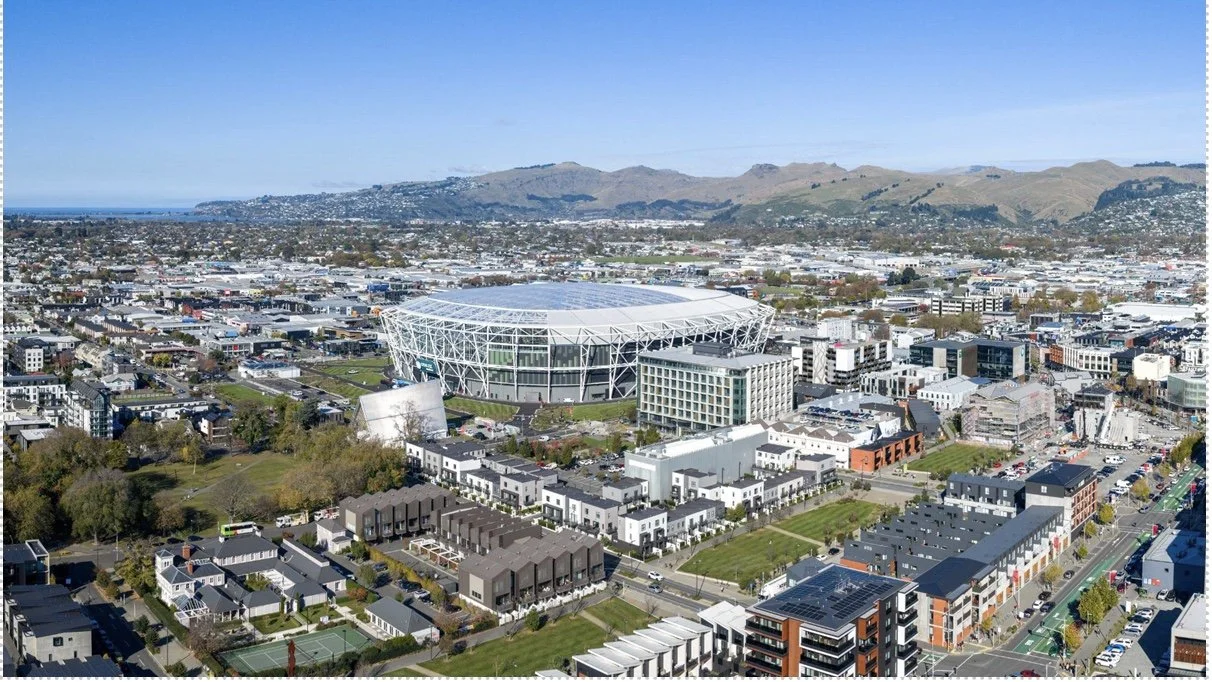
Image credit: Ōtautahi Christchurch.
Whilst reminiscent of an alien spacecraft with its ETFE roof and carapace of white steel, Te Kaha/One NZ Stadium has already become a fixture of the CBD's landscape. The structure is both practical and symbolic; six months on from opening, it has so far seen massive success, coming to stand as proof of Christchurch's long, slow rise from the rubble.
Its arrival has been a long time coming. Lancaster Park, the city's previous sporting hub, was severely damaged in the 2011 quakes, with its demolition completed in 2019. The city has waited fifteen years for a new stadium, and stakes and hopes were high for its success.
The numbers, certainly, paint an optimistic picture. Caroline Harvey-Teare, the chief executive of Te Kaha's operator Venues Ōtautahi, informed me, via email interview, that, “within the first five months of operation, the venue has hosted 69 events welcoming more than 350,000 people… within that period, the stadium's economic impact to the region has been more than $45 million from visitation alone.”
It's now a breezy, balmy Saturday evening, and Ōtautahi is abuzz with rugby fans. Tonight, Southland and Canterbury are facing off at the stadium as part of the National Provincial Championship, and supporters are flocking in droves to our new sporting mecca.
Suzy Shortland came down from Auckland to see the Farah Palmer Cup game earlier that day. She describes the stadium as “beautiful, nice, clean, [and] very warm.”
“It feels like you're closer to the field, even though I was in the cheap seats”, she said.
(When I randomly approached Shortland on Madras, she mentioned humbly that she used to play rugby herself, only for me to Google her when I got home and realise she's been part of two World-Cup winning Black Ferns squads. I'm glad to know Te Kaha has an endorsement from the pros).
Jamie Saker has only recently moved to Christchurch, but was repping red and black for the match, nonetheless. He said the stadium is “great… very easy to get in and out of, well-catered, and [it has] good viewing positions.”
Compared to Auckland, his previous home, he reported that Christchurch is “great. Much easier to get around, pretty friendly, everything's laid out pretty well… there's good design for the future.”
Saker's thoughts ring true in the stats. Despite the hard times facing Kiwis right now, Canterbury is a thriving region. We are first on the most recent ASB Regional Economic Scoreboard (released 18 September 2026) and have spent only one quarter off its podium since 2024. The report shows we have one of the lowest national unemployment rates (at 3.6%), and our core retail sales have grown 8.8% each year, the strongest rate in Aotearoa.
Harvey-Teare believes Te Kaha will keep being a contributor to Canterbury's rise and said, “the continued impressive ticket sales across the board… play a really important role [in] continu[ing] to give promoters the confidence to choose Christchurch for more major events in the future.”
It’s true Te Kaha has been, for many local businesses, a net positive. Grace, who works at Mi Piaci in the centre city, said that weekends with stadium events have brought tangible increases in sales, especially from out-of-towners. “It's been so good, actually,” she said, and added that there's been a real increase in “domestic tourists, not just people from [Christchurch].”
Ahmad Al-Mahmoud runs the Smiles 4 Miles Mashawi Grill on Hereford Street, and, although the grill has only been at that spot for a couple of weeks, he hopes the nearby stadium will boost future sales. “We haven't seen too many people at the moment,” he said, “but we've had one Saturday which was a busy day for us, so hopefully that will continue.”
Scott McCallum, a manager at the Gogi Korean BBQ restaurant (also on Hereford), doesn't have a conclusive answer for whether Te Kaha is a boon to local hospitality. “It's absolutely not negative,” he said, although he admitted “the exact crowd, what they're willing to spend before or after… there's definitely a difference.” Nevertheless, Scott said their karaoke rooms are a very popular post-match draw.
Finally, in the view of Brian Young*, a Christchurch resident who lives only a few blocks from the stadium, Te Kaha has had both positive and negative effects on locals, citing its impact on housing and voicing residents’ growing concerns about the rise of short-term accommodation in the CBD.
“It's probably been good for businesses, although getting home on a game night is rough if you try and go down Manchester… I think that Christchurch does have the potential to be on the rise, but the way that companies… are building townhouses that stay empty, except for on particular nights, because they're all… AirBnBs for the stadium, it's potentially going to make the central city crumble under itself.”
Harvey-Teare stated Venues Ōtautahi expects Te Kaha to host more than 180 events per year. “As the final major anchor project of the city's rebuild,” she said, “it represent[s]... the completion of an important chapter in Christchurch's story, and the beginning of an exciting new one.”
Te Kaha, whose name translates to 'The Strength,' is nothing if not a representation of Christchurch's resilience, and the new chapter it heralds is looking, overall, like it could be a good one.
*Pseudonym used upon request.